


The Biochar Handbook, by Kelpie Wilson
Reviewed by Tracy Frisch
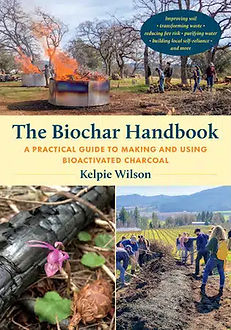
Biochar is an evocative buzzword applied to bioactivated charcoal in a successful case of rebranding. Some claim it is a climate solution because it stores carbon in the soil. But we should care more about truth and facts than about embracing silver bullets. With that in mind, here is my perspective on The Biochar Handbook.
The book shines as a backyard how-to manual on making and using biochar. Author Kelpie Wilson, a mechanical engineer and passionate biochar advocate, has been a pioneering figure in the industry since 2008. She has made biochar, refined production methods and equipment, run trials, and offered workshops for many years.
Wilson puts biochar in historical context, with interesting stories about its use in other cultures and time periods. She provides step-by-step instructions for making biochar, troubleshoots potential problems, and discusses using it in compost, improving soil, and other applications. She presents examples of benefits in soil, livestock feed, and manure odor control, drawing on her own experiences, those of colleagues, and researchers’ data. The book is attractive, with photographs and diagrams that illustrate her points effectively.
But The Biochar Handbook falls short as a source for a balanced view. Readers won’t discover that biochar has been oversold, despite widely varying claims about its benefits. Its effects and behavior vary greatly depending on the feedstock and production method, soil type, environmental conditions, crops grown, and length of the study.
I am not alone in arguing that it is premature and misleading to call biochar a climate solution because it stores carbon in soil. Very few studies have examined the fate of biochar carbon under natural conditions for even a few years, let alone centuries or millennia. We simply don’t know. Yet biochar is often equated with the pre-Columbian terra preta found in the Amazon, even though modern biochar is not the same material.
Charcoal and biochar are produced through pyrolysis, the thermal decomposition of material in a low- or no-oxygen environment. The EPA classifies pyrolysis as a type of incineration, and the process can release substantial CO2 and other pollutants.
Potential environmental and human-health impacts also deserve attention. Biochar darkens soil, causing it to absorb more heat. It eventually breaks down into tiny particles, and inhaling particulate matter is a well-documented health hazard. Polycyclic aromatic hydrocarbons (PAHs), some of which are mutagenic and carcinogenic, are also components of biochar.
Biochar production could also contribute to deforestation. The threat is not hypothetical. The early 19th-century iron industry, which relied on charcoal for smelting, left many square miles of upstate New York and surrounding areas deforested. Today, a proposed large-scale biochar project in Canada would rely on wood clearcuts from large forest tracts.
While Wilson does not advocate such projects, the backyard biochar movement and portrayal of biochar as a climate and agricultural magic bullet create a market niche for industrial production. Pyrolysis of wood and other biomass can produce particulate matter, volatile organic compounds, PAHs, nitrogen oxides, and carbon monoxide.
Biochar can also be made from sewage sludge, which may contain toxic chemicals. During a three-year campaign to stop Saratoga Biochar, LLC from producing biochar from up to 15 percent of New York State’s sewage sludge, pollution from PFAS “forever chemicals” was a major concern.
New York has no regulatory standard for biochar. Saratoga Biochar trademarked its planned sewage-sludge product as “Carbon Fertilizer,” with no required testing for phytotoxicity, heavy metals, PFAS, or other toxic substances.
I urge caution. If you make biochar, protect your lungs. If you buy it, make sure it comes from uncontaminated feedstock—not clear-cut wood—and check whether the pyrolysis plant producing it is a significant source of air pollution.


Comments